

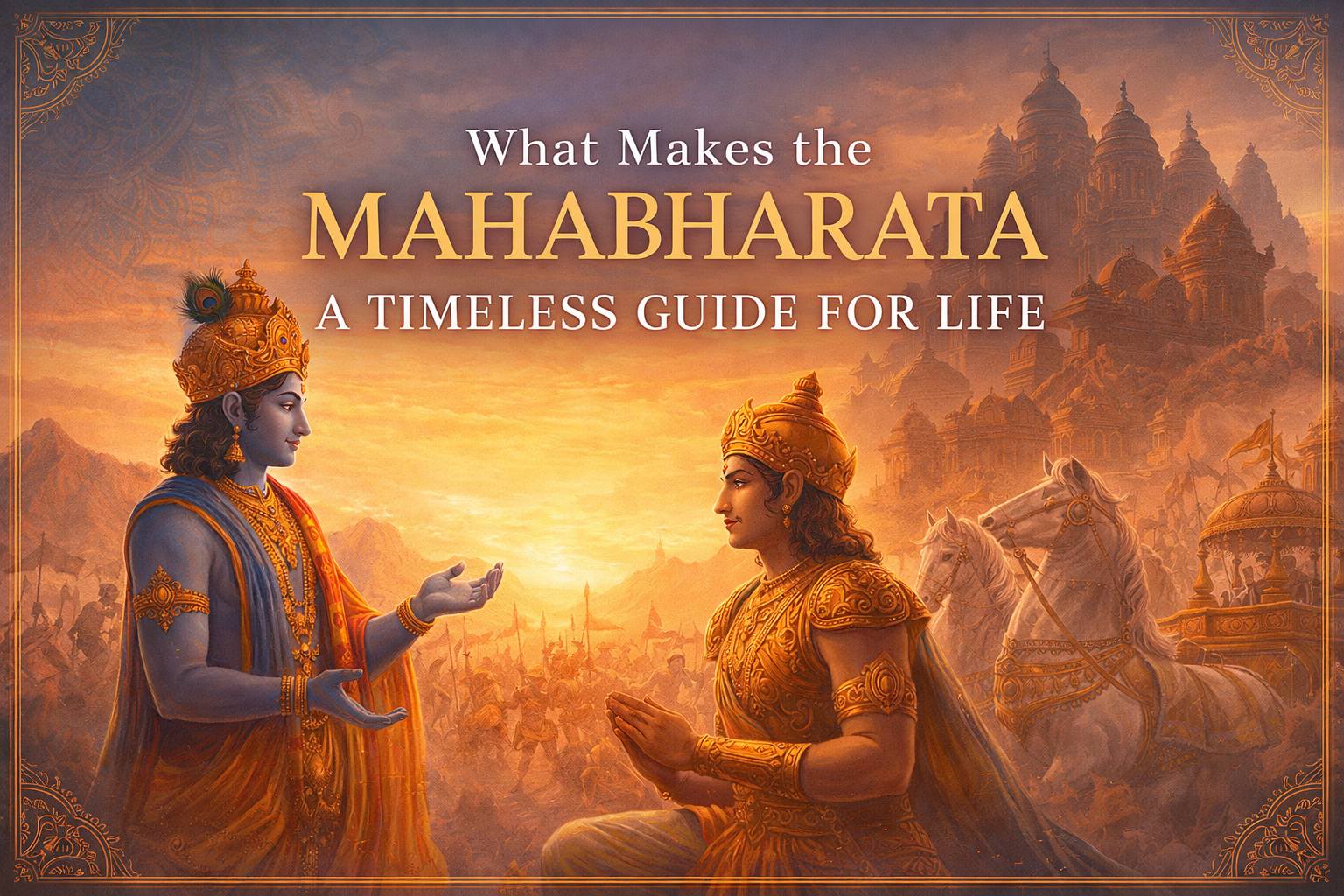
What Makes the Mahabharata a Timeless Guide for Life
Across centuries, civilizations have searched for texts that do more than narrate stories—texts that help individuals understand life, morality, conflict, and purpose. Among such works, the Mahabharata stands apart as a profound guide to human existence. Far from being only an epic of war and heroes, it is a deep exploration of human psychology, ethical dilemmas, and social responsibility. Many readers who seek to Read the complete Mahabharata in Hindi are drawn not merely by tradition, but by the epic’s ability to address timeless questions of life, duty, and conscience. Its teachings remain relevant because they do not offer rigid answers; instead, they cultivate wisdom through reflection.
What makes the Mahabharata truly timeless is its honest portrayal of life—not as an idealized moral playground, but as a complex space where right and wrong often collide. This realism is what allows the epic to guide people across generations, cultures, and changing social realities.
Life as It Is, Not as It Should Be
One of the strongest reasons the Mahabharata continues to guide human life is its refusal to present a simplistic moral universe. Characters are not divided neatly into heroes and villains. Instead, they exist in moral gray zones, much like real human beings.
Yudhishthira struggles between truth and survival, Arjuna is torn between duty and compassion, and even revered figures face ethical contradictions. These portrayals teach that life rarely offers perfect choices. The Mahabharata guides readers to accept complexity, develop discernment, and act responsibly even when outcomes are uncertain.
This realistic approach makes the epic applicable to modern life, where ethical decisions are rarely black and white.
Dharma: The Core Principle of Life Guidance
At the heart of the Mahabharata lies the concept of dharma. Unlike fixed moral rules, dharma is contextual, dynamic, and deeply personal. It asks individuals to consider their role, responsibilities, and circumstances before acting.
The epic demonstrates that dharma can differ from person to person and situation to situation. What is righteous for a king may not be righteous for a warrior or a householder. This flexible yet disciplined moral framework helps individuals navigate life with awareness rather than blind obedience.
In a world where moral absolutism often creates conflict, the Mahabharata’s interpretation of dharma offers balance and wisdom.
Human Emotions and Inner Conflict
Another reason the Mahabharata remains timeless is its deep understanding of human emotions. Fear, anger, jealousy, love, pride, and remorse are explored with psychological depth. The epic does not condemn emotions; it examines how they influence decisions.
By observing the consequences of unchecked desire or uncontrolled anger, readers learn emotional responsibility. The Mahabharata teaches that inner mastery is as important as external success. This focus on emotional intelligence makes it especially relevant in today’s fast-paced and stress-driven world.
The Bhagavad Gita: Guidance Within the Epic
Embedded within the Mahabharata is the Bhagavad Gita, one of the most influential philosophical dialogues in world literature. Its message is simple yet profound: perform your duty without attachment to outcomes.
This teaching speaks directly to modern challenges—career anxiety, fear of failure, and emotional burnout. By encouraging action rooted in purpose rather than reward, the Mahabharata offers a sustainable philosophy for long-term fulfillment.
The Gita transforms action into spiritual discipline, making everyday life a path of growth.
Leadership and Responsibility
The Mahabharata is also a powerful guide on leadership. It explores what happens when leaders lack self-control, wisdom, or ethical grounding. Through contrasting rulers and advisors, the epic illustrates that authority without responsibility leads to destruction.
True leadership, according to the Mahabharata, requires humility, listening, ethical clarity, and concern for collective welfare. These lessons are applicable not only to rulers but also to managers, parents, and community leaders today.
In an era of power struggles and ethical crises, these teachings remain strikingly relevant.
Consequences of Actions (Karma)
The principle of karma is central to the Mahabharata’s life guidance. Every action carries consequences—immediate or delayed, visible or subtle. The epic repeatedly shows how choices made in moments of desire or anger shape long-term outcomes.
This perspective encourages accountability rather than blame. Instead of focusing on fate alone, the Mahabharata emphasizes conscious decision-making. Life becomes a continuous process of learning through action and reflection.
Such an approach fosters maturity and responsibility in personal and social life.
Family, Society, and Human Relationships
The Mahabharata offers an unfiltered look at family dynamics and social obligations. It portrays love, rivalry, loyalty, betrayal, and forgiveness within familial and social structures.
By examining these relationships, readers gain insight into conflict resolution, emotional boundaries, and social harmony. The epic acknowledges that relationships are complex and require patience, empathy, and ethical judgment.
These lessons are invaluable in modern societies where family and social structures are constantly evolving.
War as a Moral Crisis, Not a Celebration
Unlike many epics, the Mahabharata does not glorify war. It presents war as a tragic consequence of moral failure, greed, and unresolved conflict. Even victory is portrayed as hollow when achieved at the cost of immense suffering.
This perspective transforms the epic into a powerful anti-war reflection. It teaches that true success lies in preventing conflict through wisdom and restraint, not in domination.
Such insight is deeply relevant in a world still grappling with violence and power struggles.
Spiritual Growth Through Worldly Life
A key reason the Mahabharata endures is its integration of spirituality with everyday life. It does not promote renunciation as the only path to wisdom. Instead, it teaches spiritual growth through engagement with responsibilities.
Work, family, duty, and struggle are presented as opportunities for inner evolution. This balanced philosophy makes the epic accessible to people living active, worldly lives.
Spirituality, in the Mahabharata, is not escape—it is awareness in action.
Adaptability Across Time and Culture
The Mahabharata has survived thousands of years because it adapts to changing contexts without losing its essence. Each generation interprets its stories according to contemporary challenges.
Whether read as philosophy, psychology, ethics, or cultural history, the epic continues to offer guidance. Its openness to interpretation allows it to remain relevant without becoming outdated.
This adaptability is the hallmark of a truly timeless guide.
Lessons for the Modern Individual
Modern life is filled with pressure—career stress, ethical dilemmas, emotional conflicts, and social responsibilities. The Mahabharata does not promise easy solutions, but it provides tools for reflection.
It teaches patience in uncertainty, courage in duty, humility in success, and acceptance in loss. These principles help individuals develop resilience and clarity amid chaos.
Such guidance is precisely what makes the epic indispensable even today.
Why the Mahabharata Transcends Religion
Although rooted in Indian tradition, the Mahabharata addresses universal human concerns. Its insights into ethics, psychology, leadership, and responsibility resonate beyond religious boundaries.
This universality allows it to function as a guide for life rather than a text limited to belief systems. It speaks to humanity as a whole, making it timeless and inclusive.
Conclusion: A Guide That Grows With You
What makes the Mahabharata a timeless guide for life is its depth, honesty, and compassion toward human complexity. It does not dictate life—it illuminates it. As readers grow and face new challenges, the epic reveals new meanings.
Rather than offering rigid doctrines, it cultivates wisdom, discernment, and self-awareness. In a rapidly changing world, such guidance is rare and invaluable.
The Mahabharata endures not because it belongs to the past, but because it continuously speaks to the present—and prepares us for the future.